Retrophilia Display Font for Handmade & Printable Products
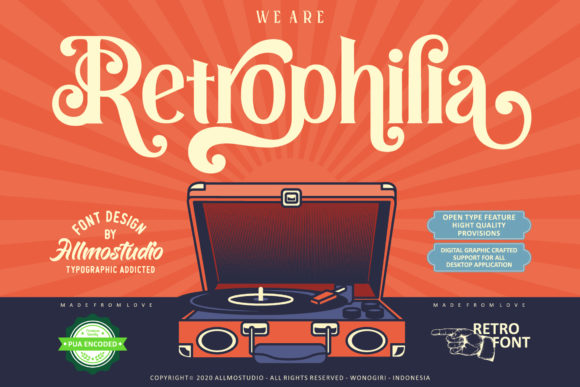
As someone who designs printable wall art, prints labels for small-batch candles, and creates SVG files for Cricut users, I’ve learned that the right display font can quietly elevate an entire product line. Retrophilia is one of those rare fonts that feels instantly familiar—like flipping through a 1970s craft catalog—but still fresh enough to stand out in today’s handmade marketplace. It’s not just “vintage-looking.” It’s thoughtfully nostalgic: rounded letterforms, subtle flares on ascenders, soft contrast, and that gentle unevenness that makes it feel hand-drawn—not sloppy, but human.
I use Retrophilia most often where personality matters more than neutrality: boutique tags, greeting cards with cheeky phrases, wedding welcome signs, seasonal packaging (think “Pumpkin Spice” on mason jar labels or “Merry & Bright” on kraft gift tags), and even planner stickers that need to pop without overwhelming. Its charm lies in how readable it stays at medium sizes—even when cut at 0.5" tall on vinyl stickers or printed at 12pt on folded invitation suites. Unlike some overly stylized retro fonts, Retrophilia doesn’t sacrifice legibility for flair. That means fewer customer questions about “What does this say?” and more “Where did you get this font?!”
For physical product makers, Retrophilia works beautifully on materials where texture enhances tone: kraft paper labels, distressed wood signs, linen-wrapped journals, and matte-finish greeting cards. When paired with warm-toned inks or muted foil stamping, it deepens the tactile experience—your product doesn’t just look handmade, it *feels* like it belongs in a curated shop rather than mass production. On digital printables, it adds instant warmth to planner pages, habit trackers, and classroom posters—especially when layered over subtle grain textures or faded photo backgrounds.
Here’s where Retrophilia shines in real projects:
- Candle & soap labels: Use it for brand names (“Hearth & Honey”) or scent descriptors (“Vanilla Tobacco,” “Lavender Rain”)—it reads clearly on 2" round stickers and holds up well when scaled down for mini sample jars.
- Wedding stationery: Perfect for “Mr. & Mrs.” on place cards, “Welcome” on chalkboard-style signage, or “Join Us” on RSVP cards—soft enough for rustic elegance, bold enough for modern farmhouse appeal.
- Digital downloads: In Canva templates or editable PDFs, Retrophilia adds visual hierarchy without requiring advanced design skills—ideal for beginner sellers offering ready-to-print party kits or boutique branding bundles.
- SVG & cutting machine files: The clean outlines and consistent stroke weight make it highly compatible with Silhouette Studio and Cricut Design Space. No jagged edges, no unexpected gaps—just smooth cuts every time.
- Seasonal crafts: Think “Cozy Season” on mug wraps, “Gather ‘Round” on holiday market banners, or “Sunshine & S’mores” on summer picnic printables—it carries cheerful nostalgia without leaning into kitsch.
Readability tips matter—especially when your font ends up on tiny product tags or mockup previews. For best results, keep Retrophilia to headlines, short phrases, and titles. Avoid body text or long paragraphs; it’s a display font by design. At sizes under 10pt (printed) or 0.3" (cut), simplify spacing and avoid tight kerning—let the letters breathe. If you’re layering it over photos or busy patterns, add a subtle white stroke or drop shadow to ensure contrast. And always test a physical print before finalizing a batch—what looks great on screen doesn’t always translate to kraft paper or textured cardstock.
Font pairing is where Retrophilia really flexes its versatility. I often pair it with a relaxed script (like a friendly handwritten font) for “hand-lettered” energy—say, “Est. 2022” in Retrophilia above “The Wildflower Co.” in a delicate script. For cleaner contrast, I’ll combine it with a neutral sans serif (think Montserrat or Lato) for ingredient lists, care instructions, or pricing details. That combo gives structure to whimsy—and helps customers scan quickly while still feeling charmed. It also supports strong brand identity: consistent use across labels, social graphics, and packaging builds recognition without needing a logo every time.
Before downloading, check what’s included: Retrophilia comes with standard OpenType features—including stylistic alternates and ligatures—that let you swap in charming variants (like a swash “Q” or connected “Th”) for special accents. It supports basic Latin multilingual characters, so it’s safe for English, Spanish, French, and German product names. File formats typically include .OTF and .TTF, both fully compatible with Adobe Creative Cloud, Affinity apps, Cricut Design Space, and free tools like Canva and Google Fonts (via upload).
One non-negotiable: verify the commercial license. As a seller, I only use fonts cleared for physical goods, digital downloads, and client work—and Retrophilia includes full commercial rights. That means you can embed it in editable Canva templates, sell SVG files with the font built-in (as vector outlines), print it on mugs and tote bags, and even license it as part of a branding package for local businesses. Just remember: you’re licensing usage, not ownership—so don’t resell the font file itself or claim it as your own design.
If you’re building a cohesive, emotionally resonant product line—whether you’re printing 50 greeting cards or launching a full Etsy shop—Retrophilia isn’t just another font. It’s a quiet confidence-builder: the kind that makes customers pause, smile, and reach for their wallet. It says “carefully made” before they even read the description. And in a crowded handmade market, that kind of unspoken credibility? That’s worth every penny.